Botanical extract potency decline: key stability drivers
Botanical extract potency decline is rarely explained by a single storage condition. Temperature, available moisture, oxygen, light, pH and the surrounding formulation can reinforce one another, so a marker assay may tell only part of the story.
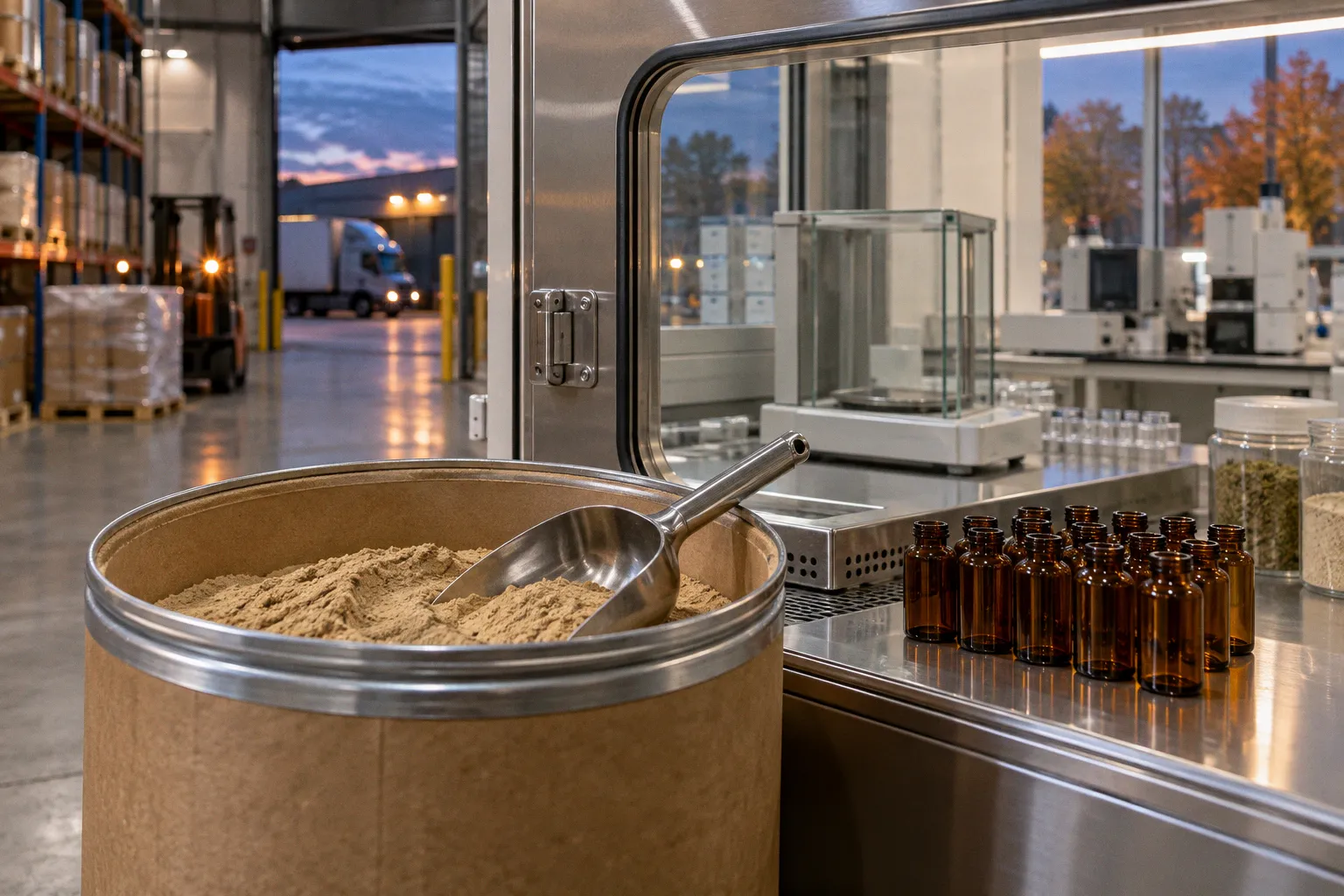
A powder and a liquid concentrate made from the same plant can age differently, and two extracts with the same declared marker can respond differently to the same warehouse conditions.
For ingredient buyers and formulators, that makes a shelf-life statement a property of a particular extract, packaging system and storage history, not a universal promise attached to a botanical. The familiar 10°C rule can help frame questions about temperature, but it cannot substitute for stability data on the material being purchased.
Thermal Kinetics and the 10°C Rule: Predicting Degradation Rates
The 10°C rule is a useful shorthand: many chemical reactions proceed faster as temperature rises, sometimes substantially. It is not a fixed multiplier for every botanical or every marker. Reaction rates depend on the compound, the matrix and the conditions around it. A dry, oxygen-limited powder may respond differently from a moist concentrate, even if both are stored at the same temperature.
The Arrhenius relationship helps explain why heat matters: reaction rates generally increase with temperature, but predicting a particular extract’s loss requires data for that system. Polyphenols, terpenes, glycosides and alkaloids do not share one degradation curve. Even within a compound class, the carrier, residual moisture, pH and packaging can alter the outcome.
This is why the “10°C rule” should guide a stability plan, not produce a shelf-life calculation on its own. Accelerated testing can help compare conditions or identify likely failure modes, but extrapolating from a short, warm study to a long ambient shelf life requires care. If reaction mechanisms shift, or if moisture and oxygen become limiting factors, a simple model may no longer describe the material well.
Temperature is a useful stress variable. It is not a stand-in for extract-specific stability data.
For procurement, the practical question is not whether a botanical can tolerate a particular temperature in the abstract. It is whether the supplier’s supporting data reflect the extract’s actual composition, carrier, packaging and intended storage conditions. A generic retest interval does not reveal what happened during transit or after a container was opened. Time-zero assay results, subsequent stability results and storage information are more meaningful when read together.
A summer shipment or a delay in a warm warehouse may add stress, but its effect cannot be translated into a precise potency loss without relevant data. Treat excursions as part of the product’s history, then assess them against the stability evidence for that material. Avoid turning a general kinetic rule into a claim that a particular lot has lost a fixed share of its marker.
The Role of Water Activity and Hygroscopy in Phytochemical Breakdown
Total moisture and water activity describe different things. Moisture content measures how much water is present; water activity, written as aw, reflects how available that water is for chemical and biological processes. Two powders with the same moisture percentage can behave differently because their ingredients bind or release water differently.
That distinction matters for hygroscopic extracts and carrier systems. Maltodextrin, sugars, proteins and inulin can each influence moisture uptake and the physical state of a blend. The effect depends on the grade, proportions, surrounding humidity and packaging. A carrier should not be assumed to be inert simply because it is familiar or widely used.
Available water can support hydrolysis and, where conditions permit, enzymatic or microbial activity. Moisture uptake may also cause caking, reduce flow and change how the powder disperses. Those visible changes are useful warning signs, but their absence does not prove that the marker profile is unchanged. Stability testing needs to follow the relevant quality attributes rather than rely on appearance alone.
A water-activity value cannot be assigned to all liquid concentrates by category. Aqueous, alcoholic, glycerin-based and other formulations have different compositions and may have different stability requirements. The same caution applies to dried extracts: a single threshold is not a universal dividing line between stable and unstable material. The useful target is the one established for the specific extract and formulation.
In practice, moisture control starts with the full packaging and handling system. A powder that leaves production dry can still absorb water through a poor closure, a permeable package or repeated exposure during use. Desiccants may help when they are compatible with the product and packaging, but they do not correct an unsuitable formulation or replace proper sealing.
For a botanical raw material shelf life assessment, it is worth asking how the supplier measured moisture and water activity, whether the values apply to the finished packaged material, and whether testing tracked changes over time. The answers are more informative than a moisture limit presented without context.
Oxidative Pathways in Lipid-Rich and Volatile Botanical Ingredients
Oxygen can alter both the measured marker and the broader chemical profile of a botanical. Lipid-rich ingredients are susceptible to oxidation, while volatile fractions may also change through evaporation, migration or reactions with other components. A marker assay can remain within specification even as the ingredient’s profile shifts, so one number may not capture every quality concern.
Oxidation is often a sequence of reactions rather than a single event. In lipid-containing systems, primary oxidation products can form before later products become evident. The timing and pattern depend on the lipid composition, oxygen exposure, light, temperature, antioxidants and packaging. For that reason, a peroxide value or another individual measure is most useful as part of an appropriate analytical plan, not as a universal verdict on every botanical.
Essential oils and terpene-rich ingredients raise a related but distinct concern: volatile compounds can migrate into the headspace or through packaging. A container may retain the main marker while the relative proportions of other constituents change. If the fingerprint matters for the intended use, analytical comparison over time can reveal changes that a single marker test would miss.
Packaging decisions should match the failure mode. Opaque materials can limit light exposure; a well-designed closure can reduce oxygen and moisture ingress; headspace management may be relevant for oxygen-sensitive or volatile ingredients. Nitrogen flushing can reduce oxygen in the package headspace, but it does not stop every oxidative pathway or compensate for an unsuitable barrier.
Stability protocols should therefore be tailored to the ingredient. Depending on the product, that may mean tracking assay results alongside an appropriate oxidation measure or chromatographic profile. The selection of tests should follow the risks identified for the extract and its formulation, rather than being attributed to a blanket requirement for all herbal materials.
Matrix Interactions: How Excipients and Microencapsulation Preserve Bioactives
A botanical extract does not age in isolation. Carriers, processing aids and other excipients affect moisture movement, oxygen exposure, light sensitivity, flow and the physical distribution of active compounds. A carrier selected only for cost or handling can create stability problems; one chosen with the extract in mind may help protect it.
Microencapsulation can create a physical barrier around sensitive constituents. Spray-drying with an appropriate wall material, for example, may help limit contact with oxygen or moisture. The result depends on the core material, wall composition, process conditions and finished particle properties. Encapsulation is not a blanket guarantee of potency retention, and results from one model system cannot automatically be transferred to another botanical.
Antioxidants can also be useful in some formulations, but their effect depends on compatibility and the reaction pathways involved. Comparing an antioxidant addition with a change in wall material requires evidence from the formulation being considered. Neither should be treated as the universally superior intervention.
| Stability consideration | Spray-dried powder | Liquid concentrate |
|---|---|---|
| Key variables | Water uptake, oxygen exposure, carrier and particle properties | Solvent system, water activity, pH, oxygen and closure |
| Potential protection | Suitable wall material and moisture-barrier packaging | Formulation choice, compatible closure and headspace control |
| What to monitor | Marker assay, physical changes and relevant profile measures | Marker assay, physical and chemical changes, and microbial quality where relevant |
| What cannot be assumed | That low moisture alone guarantees stability | That every liquid has the same water activity or shelf life |
This comparison is a starting point, not a ranking. A liquid extract in an appropriate solvent system may have a different stability profile from an aqueous concentrate; a powder’s performance depends on its carrier and packaging. The matrix and the compound class interact, so the finished formulation is the meaningful unit of evaluation.
pH Sensitivity and Sublimation Thresholds in Standardized Extracts
pH can change the stability or solubility of botanical constituents. Some phenolic and pigment-rich extracts are more vulnerable under particular pH conditions, while alkaloids and other compounds may precipitate or change form in an unsuitable matrix. There is no single pH target for botanical extracts as a class. The right range depends on the dominant constituents and the product’s intended formulation.
A pH value measured on a finished beverage or liquid blend may not describe the environment inside a dry powder. For powders, the relevant conditions may emerge only after hydration or during processing. Testing should reflect the way the ingredient is stored and used, and any pH adjustment should be assessed for its effect on both potency and physical behavior.
Volatile solids can also be lost through sublimation under suitable conditions. The risk depends on the compound, temperature, pressure, packaging and storage time. It is distinct from oxidation or hydrolysis: the material’s physical state changes, allowing some molecules to enter the vapor phase and potentially leave the product. A single threshold should not be generalized across volatile botanical ingredients.
For standardized extracts containing volatile constituents, packaging and storage should limit unnecessary heat and provide an appropriate barrier. Headspace and closure design matter because material that migrates out of the powder may be lost from the product or deposited elsewhere in the package. The relevant test is whether the chosen system maintains the required specification over the intended storage period.
A stable botanical ingredient is not simply one kept below a convenient temperature or moisture limit. Stability comes from matching the extract, formulation, package and distribution conditions, then verifying that combination over time. For buyers, the useful evidence is specific: what was tested, in which matrix and package, under what conditions, and which quality attributes remained acceptable. That is the difference between a general shelf-life expectation and a defensible specification.