Ashwagandha extract standardization: data on withanolide levels
Commercial ashwagandha extracts span roughly 1.5% to 35% total withanolides or withanolide glycosides. That range does not describe a single potency scale.
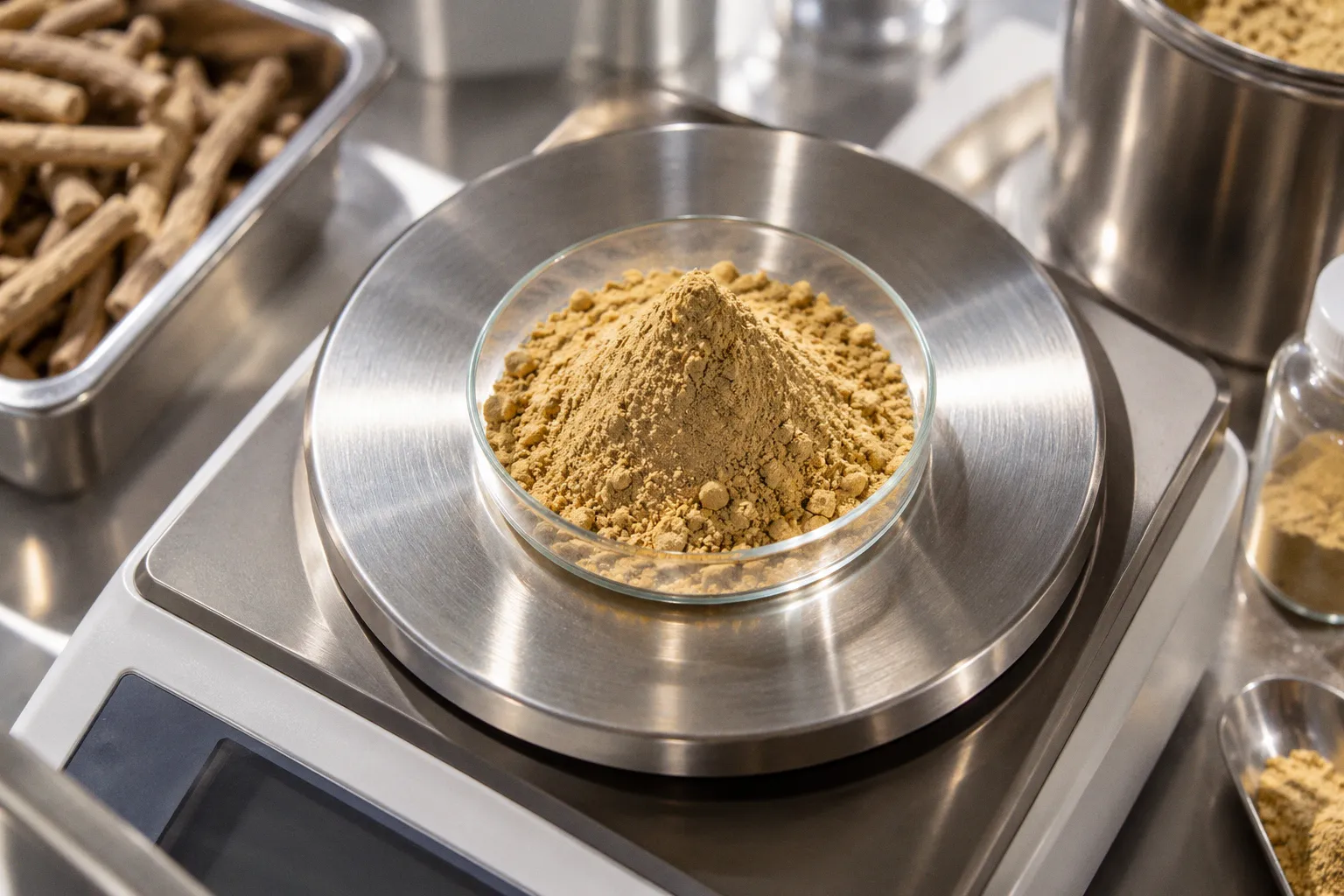
It combines materials made from different plant parts, standardized to different analyte groups and measured under different analytical conditions. A percentage on a specification sheet is therefore incomplete without its denominator, assay method and plant-part profile.
For formulators, the practical question is how the declared withanolide content translates into a reproducible raw material and a defined serving. A 5% root extract and a 35% root-and-leaf extract cannot be compared by percentage alone. Their phytochemical profiles differ, and a larger number does not establish greater clinical efficacy when serving sizes also differ.
The phytochemical spectrum: root-only versus leaf-included extracts
Ashwagandha standardization commonly quantifies steroidal lactones called withanolides, or a specified group of withanolide glycosides. These are related but not interchangeable measurements. The reported result depends on which compounds the method includes and how the extract was produced.
Plant-part composition is a primary source of variation. Root-only materials and extracts combining root and leaf tissue do not have identical phytochemical profiles. A withanolide percentage from one cannot be treated as a direct potency equivalent to the same percentage from the other. The composition of the starting biomass affects which compounds enter the extract; the analytical definition determines which of those compounds contribute to the reported value.
Three widely used branded materials illustrate the distinction:
| Extract | Plant parts | Declared standardization |
|---|---|---|
| KSM-66 | Root only | At least 5% withanolides by HPLC |
| Sensoril | Root and leaf | At least 10% withanolide glycosides |
| Shoden | Root and leaf | 35% withanolide glycosides |
The percentages in this table refer to the respective declared standardizations. They should not be read as measurements of an identical analyte pool. In particular, total withanolides and withanolide glycosides are not automatically equivalent specifications. Before comparing two materials, a buyer needs to establish whether both values refer to the same compounds, the same calculation basis and a comparable assay.
This distinction matters in product development. If a formula is designed around a target mass of withanolides, the raw-material specification must define the measured analytes. If the formula instead uses a branded extract at a fixed serving size, the product team still needs to understand what its standardization represents. Otherwise, the percentage supplies apparent precision without establishing chemical equivalence.
A withanolide percentage is meaningful only when the plant parts, analyte definition and assay method travel with it.
The available facts do not establish a universal therapeutic window for every compound in the withanolide family. Nor do they support treating root-only and root-plus-leaf extracts as interchangeable materials. Formulation decisions should preserve those distinctions in procurement specifications and finished-product calculations.
Standardization benchmarks: from 5% root extracts to 35% profiles
The commercial range of approximately 1.5% to 35% reflects different extraction and standardization profiles. It is a range of market specifications, not a ladder on which each step necessarily indicates stronger biological activity.
The contrast between 5% and 35% materials is especially visible in typical daily dosage ranges. For 5% root extracts, the reported range is 300–600 mg per day. For 35% extracts, it is 60–240 mg per day. These figures show why concentration must be interpreted alongside serving mass. A lower-percentage extract can deliver a substantial amount of standardized material at a higher daily mass; a higher-percentage extract can be used at a lower mass. The percentage alone does not establish the amount of a specific constituent reaching the consumer.
Calculating a nominal standardized fraction is straightforward when the percentage and dose share a clearly defined basis. For example, 300 mg of a material standardized to 5% corresponds nominally to 15 mg of the measured standardized fraction. That arithmetic does not prove that the fraction consists of the same individual withanolides present in another extract, or that the two materials have the same pharmacokinetics or clinical effect. It is a formulation calculation, not an efficacy comparison.
The same limitation applies when a formulator compares an extract specified at 10% with one at 35%. The result depends on whether both values refer to glycosides, whether they are measured using compatible methods and whether the profiles contain comparable compounds. Without those conditions, dividing one percentage by another produces a ratio that looks exact but does not establish equivalent exposure.
A useful specification for a standardized adaptogen raw material should therefore identify:
- The botanical plant parts used, distinguishing root-only from root-and-leaf biomass.
- Whether the standardization is stated as total withanolides or withanolide glycosides.
- The analytical method and the compounds included in the reported total.
- The target serving mass and the calculated amount of the specified analyte group per serving.
- The acceptance criteria used to assess batch-to-batch conformity.
These fields connect the raw material to the finished formula. They also reduce the risk of treating a supplier’s percentage as a complete description of composition. For procurement, the nominal assay result should be tied to an agreed method and analyte definition, rather than copied as a stand-alone marketing specification.
Analytical challenges: HPLC-UV, LC-MS and AOAC 2015.17
HPLC-based methods separate compounds in a sample before quantifying them. The separation matters because ashwagandha contains multiple individual withanolides and related compounds. A total value can conceal meaningful differences in the profile if the specification does not state which peaks or analytes contribute to the result.
AOAC 2015.17 provides HPLC guidance for separating and quantifying major individual compounds. The listed analytes include withanolide A, withanolide B, withaferin A, withanone, 12-deoxywithastramonolide, and withanoside IV and V. That level of compound-specific reporting offers a more informative basis for comparing samples than a single unnamed total.
HPLC-UV and HPLC-MS are both used in analysis, but results generated by different methods should not be assumed to be directly interchangeable. UV detection and mass spectrometry use different detection principles. The analytical protocol, reference standards, sample preparation and definition of the reported total all affect interpretation. The available information does not establish one universally mandatory method that reconciles HPLC-UV, HPTLC and LC-MS results across markets.
For a formulator, the operational requirement is method continuity. Supplier qualification, incoming-material testing and any finished-product assay should specify the measurement approach. Where two laboratories report materially different values, the comparison should begin with method details and analyte definitions, not with an assumption that one number is necessarily wrong.
A robust test report should make clear whether the stated result is a total or a set of individual analytes. It should also identify the method used to obtain it. If a specification reports total withanolides by HPLC, a separate glycoside standardization cannot be substituted without confirming that the measured groups align. Likewise, a result obtained by a different analytical platform should not be treated as directly comparable solely because both reports use the word withanolides.
This is a data-definition problem as much as a laboratory problem. A test can be technically valid for its stated purpose and still fail to answer a buyer’s comparison question if the analyte group differs from the one used in the competing specification. Standardization becomes useful when the number is reproducible and interpretable across the relevant supply chain.
Market integrity: what label deviations mean
A 2025 study published in Electrophoresis analyzed 19 commercial ashwagandha extract products. It reported deviations between measured withanolide and withanoside contents and product-label specifications by factors ranging from 2 to 35. The finding is a material warning about label accuracy. It should not be generalized into a claim that every product or every supplier has the same problem.
The reported spread also reinforces the need to distinguish the label claim from the test result. A product may declare a standardized content, but verification requires a suitable assay and a defined analyte group. If the label’s terminology is broad while the analytical result is narrower, the two values may not describe the same thing. Supplier qualification should resolve that mismatch before the ingredient is incorporated into a formula.
For B2B purchasing, the discrepancy makes documentation quality a formulation variable. A low nominal price or a high advertised percentage has limited value if the material cannot be tied to a consistent analytical specification. The relevant procurement record should link the material identity, plant-part composition, declared standardization and assay basis. Batch-level documentation then allows a formulator to assess whether delivered material remains within the agreed specification.
The 19-product study does not, on the facts available here, establish a universal rate of nonconformity across the whole market. It also does not justify assuming that all high-percentage extracts are inaccurate, or that all lower-percentage extracts are reliable. The defensible conclusion is narrower: substantial differences between label specifications and measured contents have been observed in commercial products, so an unverified label value cannot serve as analytical confirmation.
A declared standardization is a specification claim. A measured result is the evidence needed to qualify it.
That distinction matters for both ingredient selection and finished-product control. Raw-material testing addresses the incoming extract. Finished-product testing addresses the material after blending and processing, where the analytical question may include matrix effects and recovery. A supplier certificate and a finished-product assay serve different control points; neither should be treated as a substitute for the other.
Bioavailability and dosage: concentration is not exposure
A four-period crossover clinical trial published in 2025 evaluated the bioavailability of four ashwagandha extracts standardized to 35%, 10%, 5% and 2.5% withanolide glycosides under fasting conditions. The design compares exposure across extracts with differing declared concentrations. Its existence does not establish that the highest-percentage material produces the greatest clinical efficacy, particularly when dosage and extract composition vary.
Bioavailability and pharmacokinetics concern how compounds become available in the body over time. Standardization describes a chemical attribute of the ingredient. The two concepts connect, but they are not interchangeable. A percentage on a raw-material specification cannot by itself predict absorption, systemic exposure or clinical outcome. Those require evidence tied to the specific extract, dose, conditions and measured compounds.
The reported dosage ranges provide a practical starting point for understanding how manufacturers may use differing concentrations: 300–600 mg per day for 5% root extracts and 60–240 mg per day for 35% extracts. They should not be treated as universal dosing instructions or as proof that the materials are clinically equivalent. The trial’s fasting conditions are also part of its protocol. Results generated under those conditions should not automatically be projected onto every use pattern or finished-product format.
For product development, the calculation sequence should remain explicit:
1. Identify the exact standardization claim, including whether it refers to total withanolides or glycosides.
2. Confirm the plant parts and the assay method used to produce that claim.
3. Calculate the nominal amount of the specified analyte group at the intended serving mass.
4. Review bioavailability evidence for the same extract and relevant dose, rather than inferring exposure from the percentage.
5. Keep clinical claims within the evidence available for that material and regimen.
This sequence separates three questions that are often collapsed into one: what the extract contains, how much of it the serving supplies and what evidence supports its biological availability or effect. The answers may be related, but each requires its own data.
Ashwagandha extract standardization levels for supplements are therefore viable as formulation inputs only when they are defined at the level of plant part, analyte group and analytical method. A percentage without those controls is not a reliable basis for comparing raw materials. A percentage with them can support repeatable dosing, purchasing and quality control.